(And How It Hacks Modern SEO)
In my last post, I pulled back the curtain on why I’m building out a six-site multi-regional network in the Florida mortgage space using direct-type domains. The thesis was simple: entity isolation and clean geographic focus are outperforming broad national portals in modern search algorithms.
But finance is just one half of the chess board.
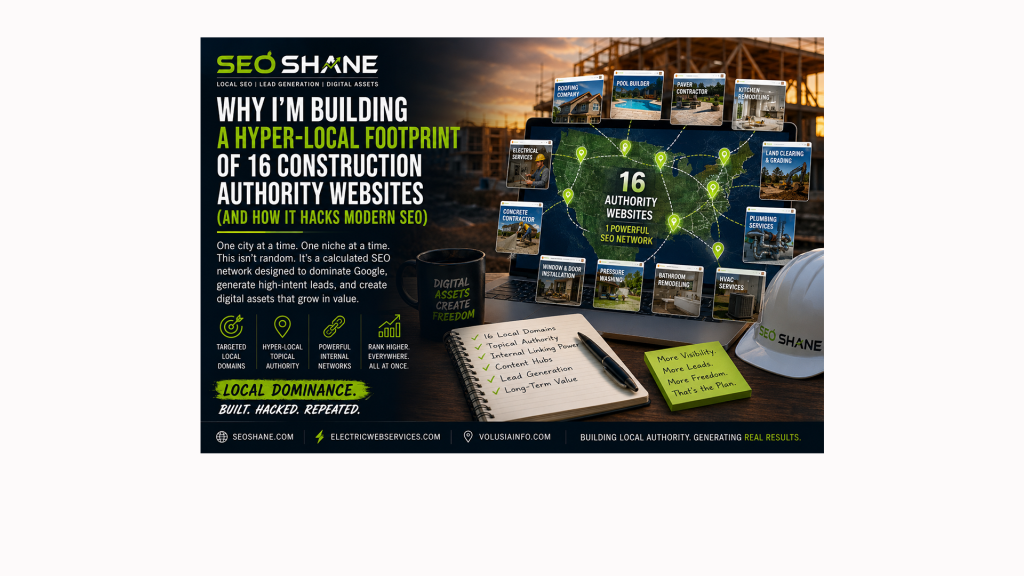
While building the mortgage framework, I simultaneously deployed a hyper-local cluster of 16 active home services and construction authority websites targeting a tight geographic corridor: Ormond Beach, Flagler Beach, Palm Coast, and New Smyrna Beach.
I didn’t build these sites to test design templates. I built them to test the limits of hyper-local topical authority.
The network targets high-intent niches—pavers, pools, custom tile, electrical, plumbing, and roofing—using exact-match, localized domain nodes (e.g., ormondpavers.com, flaglerbeachtile.com, newsmyrnabeachpools.com).
The experiment is live, and the data is loud. Across these 16 nodes, the infrastructure has captured 22 high-intent inbound project inquiries in its initial sprint.
Here is the exact architectural breakdown of why this system is working, how it forces AI search engines to attribute authority to me, and the data driving our next optimizations.
The Strategic Thesis: Hyper-Local Clustering vs. The National Giants
For years, local contractors have been held hostage by massive directory platforms like Angi, HomeAdvisor, and Thumbtack. These platforms dominate broad search phrases because of sheer legacy backlink volume.
However, search intent has fundamentally shifted. Modern algorithms—and especially LLM-driven search engines—are looking for the absolute shortest path to a trusted, localized entity.
When a homeowner searches for a custom tile shower repair or a 3-car paver driveway, a national directory forces them through multi-step forms, only to sell their information to five different companies.
Our network hacks this process by deploying Isolated Regional Nodes.
Instead of building one massive “Volusia County Contractor Directory,” we built 16 single-focus, exact-match digital assets. When Google or an AI engine crawls ormondtile.com, it doesn’t have to guess what the site is about or where the service is located. The entity definition is immediate, absolute, and unpolluted by other categories.
Analyzing the Live Lead Signals
Owning the raw data layer across 16 competing local sites gives us a unique look at local search velocity. Here is exactly what the data from our first 22 inbound leads is telling us:
1. High-Intent “Planned Purchases” Standardize Best
Out of the 22 inquiries, 10 were explicitly for paver installations, extensions, and repairs. This confirms that high-ticket, outdoor structural improvements are heavily researched via organic search. Homeowners want to see design capabilities and localized portfolios, making exact-match paver domains an incredibly high-converting asset class.
2. High-Tech Infrastructure Niche Momentum
We captured multiple direct inquiries for EV charging station installations via our Flagler Beach node. This proves that consumers treat modern, specialized electrical upgrades differently than standard home maintenance. They look for specific local specialists, allowing a dedicated niche node to easily capture the traffic.
3. The Emergency Niche Variance (Plumbing & Roofing)
While our tile, pool, and paver assets are generating highly active lead volume, our plumbing site sits at zero leads, and roofing has captured one. This isn’t a failure of the asset; it’s an illumination of consumer behavior:
Plumbing is highly transactional and reactive. If a pipe bursts, a consumer uses Google Maps or an immediate paid ad—they don’t read organic content.
Roofing is a massive financial commitment ($15k+). The conversion cycle is longer, and trust barriers are significantly higher.
The Adjustment: We are actively pivoting the plumbing and roofing nodes away from generic “repair” keywords and re-architecting them around planned high-ticket installations—specifically tankless water heater retrofits, custom home water filtration setups, and storm-restoration wind mitigation inspections.
Engineering the Machine-Readable Authority Loop
The secret weapon of this entire network isn’t just the individual front-facing content; it’s the underlying code structure connecting them back to my personal brand and core agency.
Every single one of these 16 sites now carries a unified, schema-validated infrastructure in the footer. This code explicitly communicates three data points to search bots and AI scrapers:
Contextual Hierarchy: It maps the local domain as a sub-spoke of the broader Florida Construction Network hub.
Entity Attribution: It explicitly points back to
electricwebservices.comas the engineering creator andseoshane.comas the search architect.Machine Discovery: It links directly to a central
llms.txtfile on my root agency site.
When an AI engine crawls a localized site like ormondpavers.com, it follows the digital breadcrumbs straight back to my core platforms. This means the organic success, traffic signals, and geographic authority generated by all 16 distinct sites are algorithmically credited directly to my personal brand and agency entity.
We aren’t just ranking pages anymore. We are mapping an interconnected digital ecosystem.
The pipes are laid, the assets are live, and the data proves the model. Now, it’s just time to scale it.