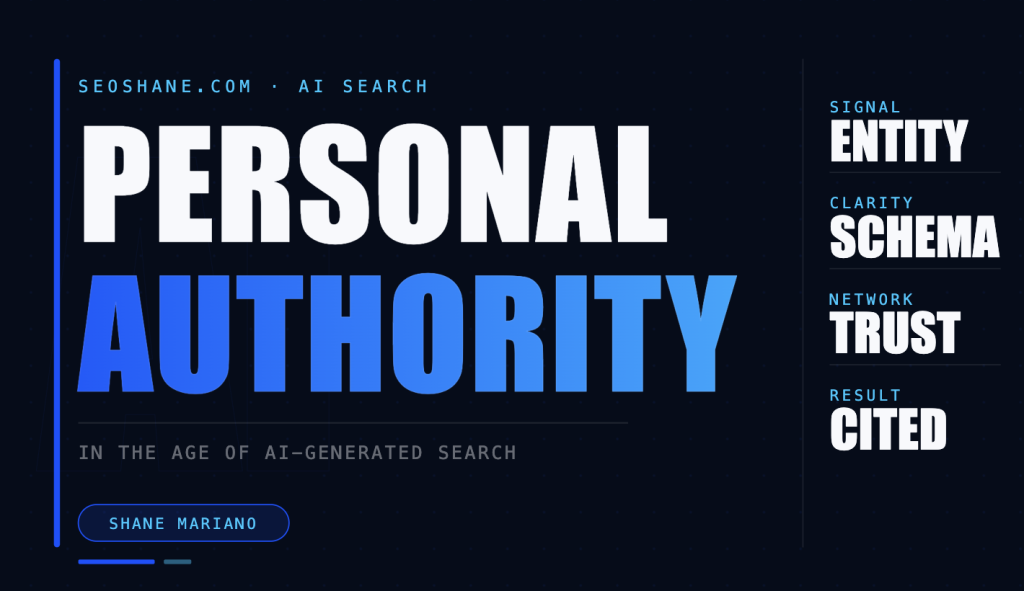
AI-generated responses favor clear entities. If your brand doesn’t have defined authority signals, you’re invisible in the next generation of search.
There’s a shift happening in search that most local businesses haven’t felt yet — but they will.
When someone asks Google’s AI Overview, ChatGPT, or Perplexity a question like “who’s the best plumber in Daytona Beach” or “what should I look for in a local SEO consultant in Florida,” those platforms don’t crawl the web in real time and return ten blue links. They generate an answer. They pull from what they already know, what they’ve indexed, and what they can verify — and they present a confident response with a handful of sources attached.
If your business or personal brand isn’t part of what those systems already know, you don’t get mentioned. You don’t even get skipped. You simply don’t exist in that answer.
This is what’s changing search. And it’s why personal authority — real, structured, documented authority — matters more right now than it ever has.
The shift from keywords to entities
Traditional SEO was built around keywords. You figured out what people were searching, you put those words on your pages, and Google matched your content to those queries.
AI search doesn’t work that way. The large language models powering these platforms don’t think in keywords. They think in entities — people, places, businesses, concepts — and the relationships between them.
An entity, in this context, is anything that can be clearly defined and distinguished from everything else. Shane Mariano, the digital marketing strategist based in Ormond Beach, Florida, with 13 years of experience in local SEO and Google Ads — that’s an entity. A generic “local marketing guy” with no consistent name, no defined location, no documented credentials, no cross-referenced mentions — that’s noise.
AI systems are trained to favor entities they can verify. If the signals around your brand are consistent, structured, and present across multiple authoritative sources, the model gains confidence that you’re real, relevant, and trustworthy. If those signals are absent, contradictory, or thin, the model either ignores you or, worse, gets you wrong.
What “authority signals” actually means
The phrase gets thrown around a lot, but in the context of AI search it has a specific meaning. Authority signals are the structured, cross-referenced markers that help AI systems understand who you are, what you do, and why you’re credible.
Here’s what that looks like in practice:
A consistent entity name. Your name or business name should appear identically across your website, Google Business Profile, social profiles, directories, and any external mentions. Variations and inconsistencies create ambiguity. AI models prefer certainty.
A defined location and service area. “Ormond Beach, FL” is a clear geographic entity. It ties you to a place, a market, a community. Vague or missing location data makes it harder for AI to include you in geographically relevant answers.
Documented expertise. What do you specifically know about? What have you written, said, or been cited for? AI systems look for topical consistency. If your content, your profiles, and your external mentions all point to the same areas of expertise, that builds a coherent knowledge signal.
Cross-referenced mentions. The more often your name and brand appear on external sites — industry publications, local news, business directories, partner sites — the stronger the signal. This is essentially what links have always done for traditional SEO, but the mechanism in AI search goes deeper. It’s not just about the link. It’s about the co-occurrence of your entity alongside other trusted entities.
Structured data on your site. Schema markup (Person, LocalBusiness, ProfessionalService, FAQPage) gives AI systems machine-readable information about who you are and what you do. It’s the difference between a platform having to guess your role from the surrounding text and being told directly.
Why personal brands have an advantage here
Businesses have always competed on visibility. But AI search introduces a dimension that favors individual people over faceless companies — especially in local and professional service markets.
AI-generated responses increasingly include named people, not just business names. When someone asks for a recommendation, the model is more likely to surface “Shane Mariano, a local SEO specialist based in Ormond Beach” than “a digital marketing agency in Volusia County.” The person has a face, a name, a documented history. The entity is clear.
This is a genuine opportunity for anyone building a personal brand alongside — or instead of — a company brand. If your name is consistently associated with a specific area of expertise, in a specific market, across multiple sources, you become the kind of entity that AI systems can confidently cite.
The businesses and professionals who figure this out now, while most of their competitors are still thinking in purely keyword terms, will have a significant structural advantage as AI search becomes the default way people find local services.
What most local businesses are getting wrong
The most common mistake isn’t doing the wrong things. It’s doing nothing with intention.
Most local businesses have a Google Business Profile that was set up years ago and hasn’t been touched since. They have a website that mentions their services but doesn’t clearly define who they are as an entity. They have no schema markup. Their name appears slightly differently across directories. They have no published content that documents their expertise. And they have almost no external mentions outside of a few directory listings.
In traditional SEO, this is a missed opportunity. In AI search, it’s a structural barrier. These systems can’t confidently surface what they can’t confidently understand.
The fix isn’t complicated, but it does require intention:
- Audit every place your name or business name appears online and standardize it
- Complete and regularly update your Google Business Profile — posts, photos, Q&A, services
- Add Person and LocalBusiness schema to your website
- Publish content that consistently addresses the specific topics you want to be known for
- Build external mentions through local press, industry sites, guest content, and partnerships
- Create a clear “about” footprint — a bio, a professional history, a defined area of expertise — that appears consistently wherever you show up
None of this is exotic. All of it compounds.
The network effect of a connected brand ecosystem
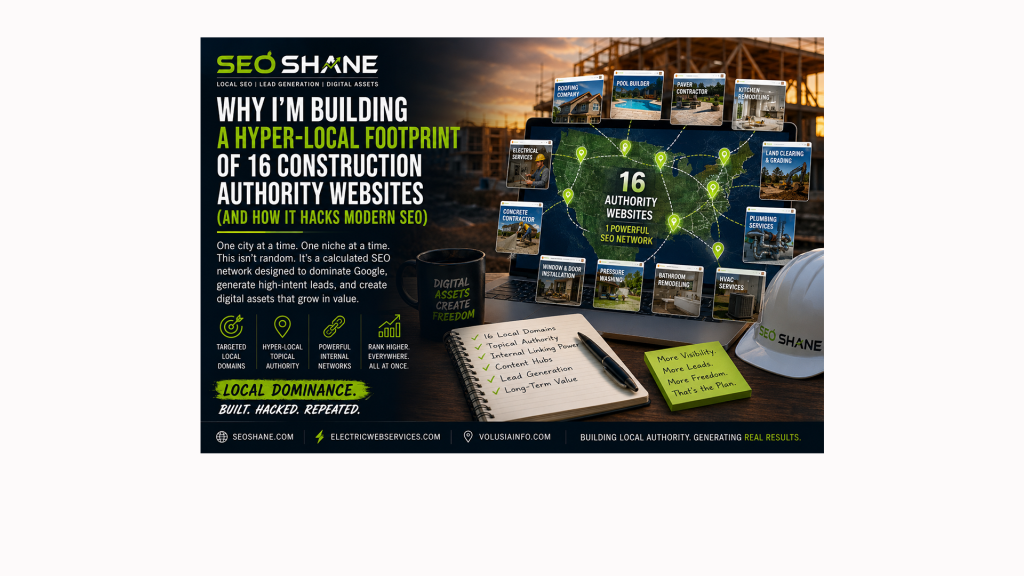
One of the most effective ways to build entity clarity is through a connected brand network — multiple properties that each reference and reinforce each other.
This is the model behind Shane Mariano, Electric Web Services, and SEOShane. Each property is a distinct entity with its own purpose. But they all reference the same person, the same location, the same areas of expertise. Cross-links, consistent bios, shared schema relationships, and overlapping content topics create a web of signals that AI systems can triangulate.
When a model encounters “Shane Mariano” on one site, finds a matching entity on a second site, and then sees that name cited on a third — and all three are consistent — confidence goes up. The entity becomes real, not just a name on a page.
This is entity SEO at a practical level. You don’t need a massive network. Even two or three well-structured, consistently branded properties can create a signal that a single isolated website can’t.
This isn’t replacing traditional SEO — it’s layering on top of it
None of this means keywords are dead or that traditional local SEO no longer matters. Google Maps results still depend on proximity, review volume, GBP completeness, and citation consistency. Organic rankings still reward on-page relevance and backlinks.
But AI search is becoming the first layer — the place where intent is formed before a person ever clicks a link. If you’re not present in that layer, you’re competing for the traffic that’s left after the AI has already answered the question.
The businesses that win over the next three to five years will be the ones that built entity clarity early, when most of their competitors weren’t paying attention.
That means publishing consistently. Structuring your data correctly. Maintaining a coherent brand footprint across every touchpoint. And making it easy for AI systems to understand exactly who you are, what you do, and why someone in your market should trust you.
Visibility used to mean ranking on page one. Increasingly, it means being the answer.
Shane Mariano is a digital marketing strategist based in Ormond Beach, FL, specializing in local SEO, Google Ads, and AI search visibility. Learn more at shanemariano.com or read more search strategy at seoshane.com.